As business infrastructure grows, a standard shared rack or single cabinet may no longer be enough. Companies with multiple servers, storage systems, network equipment, backup infrastructure, or stricter security requirements may need a more private data center environment.
Two common options are private cages and private suites.
Both give businesses more dedicated infrastructure space than standard rack colocation. Both can support larger environments, stronger access control, and future growth. However, they are not the same.
A private cage provides a dedicated, secured area inside a shared data center space. A private suite usually provides a more separated, enclosed, and customized infrastructure area. The right choice depends on your security needs, compliance requirements, rack count, growth plans, budget, and operational preferences.
This guide explains the difference between a private cage and a private suite so businesses can choose the right data center environment.
What Is a Private Cage in a Data Center?
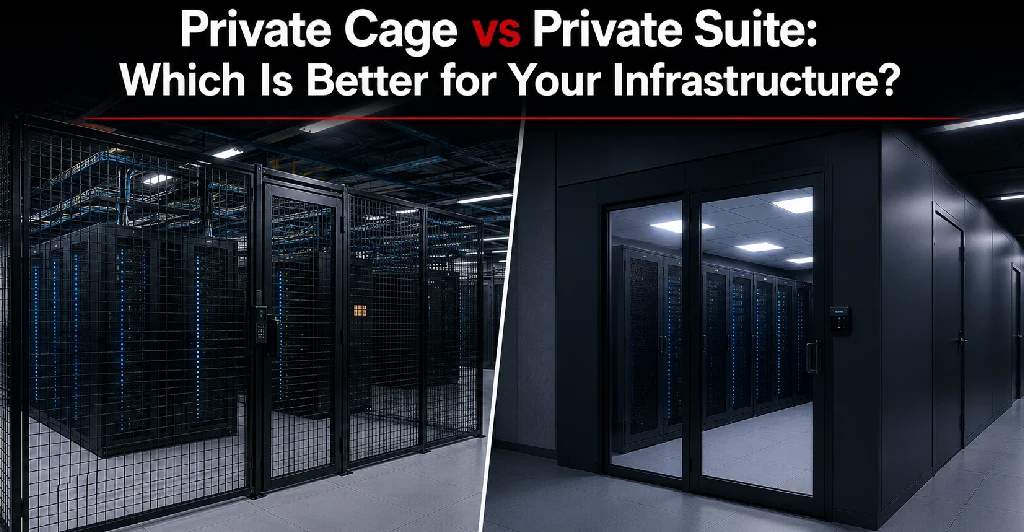
A private cage is a dedicated, secured space inside a data center where a business can place its own racks, cabinets, servers, storage, and network equipment.
The cage is usually separated by physical fencing, mesh, or secure partitions. Access is restricted to authorized users, approved vendors, or data center staff following documented procedures.
A private cage gives businesses more control and separation than a shared rack or individual cabinet while still using the data center’s shared facility infrastructure.
This may include:
- Power
- Cooling
- Physical security
- Carrier connectivity
- remote hands support
- Facility monitoring
- Backup power
- Environmental controls
Private cages are commonly used by businesses that need multiple racks, stronger physical security, or room to expand without moving into a fully separate suite.
What Is a Private Suite in a Data Center?
A private suite is a more dedicated and enclosed data center space. It may be a separate room, an enclosed area, or a customized environment built for one customer’s infrastructure.
Private suites are often used by businesses with larger deployments, stricter security requirements, higher compliance needs, or specialized infrastructure designs.
A private suite may provide more control over:
- Room layout
- Access control
- Rack placement
- Cabling design
- Power distribution
- Cooling configuration
- Security procedures
- Vendor access
- Expansion planning
A suite can offer a higher level of physical separation than a cage, depending on the facility design.
For enterprise organizations, healthcare providers, financial services companies, manufacturers, or multi-location businesses, a private suite may be useful when infrastructure is large, sensitive, or mission-critical.
Private Cage vs Private Suite: Main Difference
The main difference is the level of separation, customization, and control.
A private cage gives the business a dedicated, secure area within the data center floor. It is more private than shared rack space but still part of the larger data hall environment.
A private suite is usually a more enclosed or separately defined space. It may offer stronger physical separation, more customization, and a higher level of control over layout and access.
In simple terms:
- A private cage is usually best for businesses that need dedicated space and access control without a fully separate room.
- A private suite is usually best for businesses that need larger, more controlled, or more customized infrastructure space.
For a direct breakdown of these two models, review our detailed guide on private cage vs private suite.
When a Private Cage Makes Sense
A private cage may be the right choice when a business has outgrown standard rack space but does not need a full private suite.
A private cage may be suitable for businesses that need:
- Multiple racks or cabinets
- Dedicated secured space
- Stronger access control than shared colocation
- Room for growth
- Separate the infrastructure from other customers
- Better organization for servers and network equipment
- Compliance support
- Cost-effective private space
- Carrier-neutral connectivity access
- Remote hands support
Private cages are often a practical next step for businesses that started with shared rack space or a full cabinet and now need more room, security, and scalability.
When a Private Suite Makes Sense
A private suite may be better when infrastructure requirements are larger or more sensitive.
A private suite may be suitable for businesses that need:
- A larger dedicated environment
- More physical separation
- Stronger access control
- Custom rack layout
- Dedicated infrastructure zones
- Higher compliance alignment
- Specialized cabling or connectivity design
- More controlled vendor access
- Long-term infrastructure expansion
- Enterprise-grade operational control
Private suites are often used when the infrastructure environment is central to business operations and requires a more customized data center footprint.
Security Comparison
Security is one of the biggest reasons businesses consider private cages or suites.
A private cage improves security by giving the customer a dedicated area with restricted access. It separates customer equipment from shared rack environments and creates a clear physical boundary. For teams auditing potential vendors, it helps to review what to look for in a secure data center facility to ensure all threshold metrics are met.
A private suite may provide even stronger separation, depending on the facility. Since it may be an enclosed room or more controlled space, it can support stricter access procedures and more customized security controls.
Businesses should ask:
- Who can access the space?
- How is access approved?
- Is access logged?
- Are cameras monitoring the area?
- Are visitors escorted?
- Can vendor access be restricted?
- Are access records available for audits?
- Can remote hands work inside the space?
- How are emergency access procedures handled?
For sensitive or regulated infrastructure, access control documentation may be just as important as the physical boundary itself.
Compliance Considerations
Businesses in regulated industries may need stronger documentation, access control, and infrastructure separation.
This can include organizations in:
- Healthcare
- Financial services
- Manufacturing
- infrastructure for enterprise
- Legal services
- Insurance
- Government-related contracting
- Multi-location operations
A private cage may support compliance needs when dedicated space, logged access, and restricted entry are sufficient.
A private suite may be preferred when the business needs more separation, more customized controls, or a higher level of infrastructure isolation. Organizations should run through a formal data center compliance checklist to weigh their choices accurately.
Compliance requirements vary by industry and organization, so businesses should evaluate the data center environment alongside their internal compliance obligations.
Access Control
Access control is an important difference between shared rack space, private cages, and private suites.
With standard rack space, access may be limited to a cabinet or shared area. With a private cage, access is limited to a secured cage area. With a private suite, access may be limited to a more enclosed or dedicated room.
Businesses should review:
- Authorized user lists
- Badge access
- Visitor procedures
- Vendor escort requirements
- Remote hands authorization
- Emergency access policies
- Access logs
- Audit support
If multiple internal teams, vendors, or compliance stakeholders require controlled access, a private cage or suite can make infrastructure operations easier to manage.
Rack Space and Growth
Rack space is another major factor.
A private cage can support multiple racks in a dedicated area. It is useful when the business needs more than one cabinet and expects future growth. To optimize your footprint, calculate exactly how much rack space your business needs before mapping your layout.
A private suite may support larger deployments and more customized layouts. It can provide more flexibility for companies planning long-term infrastructure expansion.
When comparing options, businesses should consider:
- Current rack count
- Future rack count
- Power density
- Cooling requirements
- Cabling complexity
- Network equipment
- Backup systems
- Disaster recovery infrastructure
- Space for future hardware
- Maintenance access
A business should avoid choosing a space that is already near capacity on day one.
Power Planning
Private cages and private suites both require careful power planning.
Businesses should evaluate:
- Total power required
- Power per rack
- Redundant power feeds
- A and B power availability
- Power distribution units
- Circuit capacity
- Future power growth
- High-density equipment
- Monitoring and reporting
A complete understanding of power redundancy in a data center is foundational here to protect your mission-critical operations. A private cage may be enough if power requirements are moderate and can be supported within the cage design.
A private suite may be a better fit when the business needs larger power capacity, more customized power distribution, or more complex infrastructure planning. Power needs should always be reviewed alongside cooling and rack density.
Cooling Planning
Cooling requirements become more important as infrastructure grows.
A private cage must be designed so equipment receives proper airflow within the larger data center environment. Rack placement, cable management, and equipment density all matter. Having data center cooling explained helps system architects configure their aisles appropriately.
A private suite may offer more flexibility for customized cooling design, depending on the facility.
Businesses should ask:
- How is cooling delivered to the private space?
- Can the environment support current and future heat loads?
- Are hot spots monitored?
- Is there cooling redundancy?
- Are temperature and humidity monitored?
- How does rack density affect cooling?
- Are cooling systems supported by backup power?
A larger private environment should be planned carefully to avoid overheating, poor airflow, or expansion limits.
Connectivity Requirements
Connectivity can also influence the decision.
A private cage may be a strong fit for businesses that need multiple carriers, cross-connects, firewalls, VPN equipment, and network redundancy.
A private suite may be better when the network environment is larger or more complex, especially for enterprises, multi-location companies, or organizations with private network architecture.
Businesses should review:
- Carrier-neutral connectivity
- Cross-connect availability
- Internet bandwidth needs
- Redundant network paths
- Cloud connectivity
- Firewall placement
- Switch architecture
- Private network connections
- Remote access needs
The private space should support both current connectivity and future network growth.
Remote Hands Support
Remote hands support is important for both private cages and private suites.
Data center technicians may assist with physical tasks such as:
- Checking equipment
- Rebooting servers
- Verifying cables
- Replacing hardware
- Installing patch cables
- Escorting vendors
- Receiving equipment
- Supporting troubleshooting
For private environments, the business should understand how remote hands access is authorized and documented.
Questions to ask include:
- Can remote hands access the private cage or suite?
- Who can authorize access?
- Are tasks documented?
- Are photos or updates available?
- Are emergency requests handled differently?
- Can vendors be escorted?
- Are after-hours requests supported?
Remote hands can make private infrastructure easier to operate, especially when internal IT staff are not always on-site.
Cost Comparison
Private cages usually cost less than private suites because they provide dedicated secured space without the same level of enclosure or customization.
Private suites usually cost more because they may involve more dedicated space, more infrastructure planning, stronger separation, and greater customization.
Cost may be affected by:
- Square footage
- Number of racks
- Power requirements
- Cooling requirements
- Connectivity needs
- Security requirements
- Access procedures
- Remote hands usage
- Buildout needs
- Contract length
- Future expansion
The lower-cost option is not always the best option. The right choice depends on business risk, infrastructure importance, compliance requirements, and long-term growth.
Operational Flexibility
Private cages and private suites both give businesses more operational flexibility than standard rack space.
A private cage can make it easier to organize multiple racks, separate network and server equipment, and add capacity over time.
A private suite may provide more flexibility for custom layouts, dedicated infrastructure zones, and complex deployments.
Businesses should consider how the space will be used day to day:
- Who will access the equipment?
- How often will hardware be changed?
- How often will vendors need access?
- Will new racks be added?
- Will backup infrastructure grow?
- Will network architecture become more complex?
- Will compliance reviews require documentation?
The right space should make operations easier, not more difficult.
Private Cage vs Private Suite for Small and Mid-Sized Businesses
Small and mid-sized businesses may not need a private suite immediately.
A private cage can be a strong fit when the business needs more security and growth room than a standard cabinet but wants to control cost.
A private cage may support:
- Several racks
- Core business applications
- Backup infrastructure
- Network equipment
- Disaster recovery systems
- Future expansion
A private suite may make sense for an SMB if infrastructure is highly sensitive, fast-growing, or central to business operations.
For many SMBs, the decision comes down to balancing security, growth, and budget.
Private Cage vs Private Suite for Enterprise Infrastructure
Enterprise organizations often have more complex requirements.
They may need:
- Larger deployments
- Multiple racks
- Segmented environments
- Strict access controls
- Compliance documentation
- Higher power density
- Redundant connectivity
- Vendor access procedures
- Long-term expansion planning
A private cage may work for enterprise environments with moderate space and security needs.
A private suite may be better when the infrastructure requires stronger separation, custom layout, or a larger dedicated footprint.
Private Cage vs Private Suite for Healthcare
Healthcare organizations often need secure and reliable infrastructure for patient systems, administrative platforms, imaging systems, data backups, or other critical workloads. Deploying within a hipaa compliant data center hosting space ensures full structural protection for patient health data.
A private cage may help healthcare providers separate infrastructure, control access, and support uptime planning using data center hosting for healthcare providers.
A private suite may be appropriate when the organization has larger infrastructure needs, stricter internal policies, or more sensitive environments. Healthcare organizations should evaluate the facility’s security, access controls, compliance support, uptime, backup power, and disaster recovery options before choosing.
Private Cage vs Private Suite for Financial Services
Financial services companies may depend on secure, available infrastructure for customer data, transaction systems, reporting platforms, internal applications, and compliance-related systems.
A private cage may support dedicated infrastructure with controlled access.
A private suite may be preferred for larger or more sensitive environments where separation, custom security procedures, and long-term capacity planning are important. Implementing tailored data center solutions for financial services provides the rigorous logging and physical boundaries necessary for financial audits.
Private Cage vs Private Suite for Manufacturing
Manufacturing businesses may rely on infrastructure for ERP systems, inventory management, plant operations, logistics, and multi-location connectivity.
A private cage can support centralized infrastructure, backup systems, and network equipment in a secure data center environment. A clear understanding of why manufacturers need reliable data center infrastructure helps explain why shared environments are often phased out as plant automation expands.
A private suite may be useful when the manufacturer has multiple locations, larger infrastructure needs, or more complex network requirements. For manufacturing, reliability and connectivity may be just as important as physical security.
Questions to Ask Before Choosing
Before choosing between a private cage and a private suite, ask:
- How many racks do we need today?
- How many racks will we need in the next few years?
- What are our power requirements?
- What are our cooling requirements?
- Do we need dedicated physical separation?
- What access controls are required?
- Do we have compliance requirements?
- How often will staff or vendors need access?
- How much network equipment will be installed?
- Do we need multiple carriers or cross-connects?
- Do we need disaster recovery infrastructure?
- How important is future expansion?
- What is the cost difference?
- What operational support is included?
- Does the provider offer remote hands support?
These questions help clarify whether a private cage or private suite is the better fit.
Private Cage vs Private Suite Checklist
Use this checklist when comparing options:
- Current rack count
- Future rack count
- Security requirements
- Compliance requirements
- Access control needs
- Vendor access needs
- Power capacity
- Cooling requirements
- Connectivity requirements
- Cross-connect needs
- Network redundancy
- Remote hands support
- Disaster recovery plans
- Cabling complexity
- Growth flexibility
- Budget
- Long-term infrastructure strategy
This checklist helps businesses choose based on operational needs, not only price.
Which Option Is Better?
A private cage is usually better when the business needs dedicated, secured space, multiple racks, access control, and room to grow without the cost or complexity of a private suite.
A private suite is usually better when the business needs a larger, more separated, more customized, or more controlled infrastructure environment.
The best option depends on the importance of your infrastructure, the size of your deployment, your compliance needs, and your expected growth. For regional deployments, understanding why regional data centers matter will also dictate whether you split equipment across sites or concentrate it in one hub.
For many businesses, a private cage is the next step after standard colocation. For larger or more sensitive environments, a private suite may provide the control needed for long-term infrastructure planning.
Plan Private Infrastructure With Sierra Data Centers
Sierra Data Centers supports businesses with secure colocation, private cages, private suites, data center hosting, carrier-neutral connectivity, remote hands support, and disaster recovery planning.
Whether your organization needs dedicated cage space, a private suite, or a scalable colocation environment, we can help evaluate your infrastructure requirements and growth plans.
If your business is comparing private cage and private suite options, Sierra Data Centers can help you choose a secure, reliable environment that supports your operations.
Ready to design your setup? Contact us today to speak to an infrastructure architect.