As businesses become increasingly dependent on cloud applications, remote work, real-time communications, and digital services, network connectivity has become one of the most important components of IT infrastructure.
When evaluating data centers and hosting providers, you’ll often hear the term carrier-neutral connectivity. While it may sound technical, the concept is relatively simple—and it can have a major impact on performance, reliability, flexibility, and long-term costs.
In this guide, we’ll explain what carrier-neutral connectivity means, how it works, and why many organizations consider it a critical feature when selecting a data center provider.
What Does Carrier-Neutral Mean?
A carrier-neutral facility is a data center that allows customers to connect to multiple telecommunications and internet service providers (carriers).
Instead of being tied to a single network provider, businesses can choose from a variety of carriers operating within the facility.
These may include:
- Internet service providers (ISPs)
- Telecommunications carriers
- Fiber providers
- Cloud connectivity providers
- Private network providers
The data center itself does not require customers to use a specific carrier.
Instead, customers have the freedom to select the providers that best meet their technical and business requirements.
The Alternative: Carrier-Specific Facilities
Some facilities operate under a single-carrier model.
In these environments:
- Connectivity is limited to one provider.
- Pricing options may be restricted.
- Redundancy choices may be limited.
- Customers have less flexibility.
Carrier-neutral facilities eliminate these limitations by providing access to multiple network options.
For a deeper comparison of these models, see our guide on single-carrier vs carrier-neutral data centers.
How Carrier-Neutral Facilities Operate
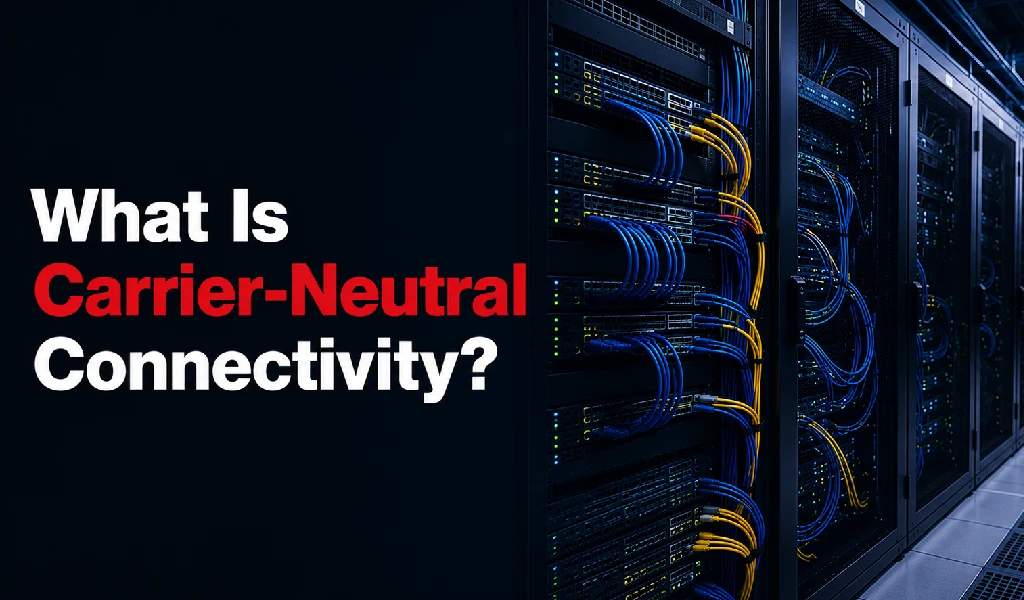
Carrier-neutral data centers function as connectivity hubs where multiple providers establish a presence within the same facility.
Businesses that colocate or host infrastructure in the data center can connect directly to these carriers.
Shared Connectivity Ecosystem
Within a carrier-neutral facility, multiple network providers maintain infrastructure such as:
- Fiber connections
- Network equipment
- Interconnection points
- Private network services
Customers can select one or several providers depending on their needs.
Cross-Connect Services
Most carrier-neutral facilities offer cross-connects, which are direct physical connections between a customer’s infrastructure and a chosen carrier.
These connections provide:
- Faster communication
- Lower latency
- Greater reliability
- Enhanced security
Cross-connects are often used to connect businesses directly to:
- Internet providers
- Cloud platforms
- Business partners
- Other data centers
Multiple Carrier Access
Organizations may use:
- A single carrier
- Dual carriers
- Multiple carriers
Depending on performance, redundancy, and business continuity requirements.
This flexibility is one of the primary advantages of carrier-neutral environments.
Benefits of Carrier-Neutral Connectivity
Carrier-neutral connectivity offers several important advantages over single-provider environments.
Improved Reliability
Network outages can occur even with highly reputable providers.
When multiple carriers are available, businesses can implement redundant connections that reduce the risk of downtime.
If one provider experiences an issue, traffic can often be rerouted through another network.
Organizations looking to strengthen uptime strategies should understand connectivity redundancy and its role in resilient network design.
Greater Business Continuity
Carrier diversity is a critical component of business continuity planning.
Redundant connectivity helps ensure:
- Application availability
- Customer access
- Employee productivity
- Operational resilience
Even during carrier-specific disruptions.
Reliable connectivity is a major factor in maintaining operational resilience. Learn more about how connectivity impacts business continuity.
Better Performance
Different carriers may offer different routing paths and performance characteristics.
Businesses can select providers based on:
- Latency requirements
- Geographic coverage
- Application performance
- Service quality
This allows organizations to optimize connectivity for their specific workloads.
Reduced Vendor Lock-In
Carrier-neutral facilities prevent organizations from becoming dependent on a single provider.
Businesses maintain the freedom to:
- Change carriers
- Add new providers
- Negotiate pricing
- Expand connectivity options
Without relocating infrastructure.
Future Flexibility
As business requirements change, connectivity strategies can evolve without requiring major infrastructure changes.
This flexibility supports long-term growth and technology planning.
Cost Advantages of Carrier-Neutral Connectivity
While reliability and flexibility often receive the most attention, carrier-neutral environments can also provide financial benefits.
Competitive Pricing
When multiple carriers compete within the same facility, customers gain stronger negotiating leverage.
This often leads to:
- More competitive pricing
- Better service packages
- Improved contract flexibility
Competition benefits customers.
Reduced Migration Costs
In a carrier-specific facility, changing providers may require significant infrastructure changes or even relocation.
Carrier-neutral environments simplify carrier transitions, reducing disruption and potential migration expenses.
Infrastructure Optimization
Organizations can choose carriers based on performance and budget requirements rather than being forced into a single solution.
This flexibility often results in more efficient spending over time.
Avoiding Single-Provider Risk
The cost of downtime can quickly outweigh any perceived savings from a lower-cost network provider.
Carrier diversity helps mitigate this risk.
Connectivity Flexibility
Modern IT environments are more interconnected than ever.
Organizations frequently require connections to:
- Public cloud platforms
- Multiple office locations
- Remote employees
- Business partners
- SaaS applications
- Disaster recovery environments
Carrier-neutral facilities provide the flexibility needed to support these complex requirements.
Multi-Carrier Strategies
Many organizations deploy:
- Primary carriers
- Secondary backup carriers
- Dedicated network circuits
- Private cloud connections
This layered approach improves both performance and resilience.
Hybrid Infrastructure Support
Carrier-neutral connectivity supports hybrid environments that combine:
- Colocation
- Dedicated hosting
- Public cloud
- Private cloud
- Disaster recovery sites
Organizations gain the freedom to design infrastructure based on business needs rather than connectivity limitations.
Businesses leveraging colocation services, cloud computing solutions, and disaster recovery strategies often rely on carrier-neutral connectivity to seamlessly connect these environments.
Easier Expansion
As new locations, applications, or services are added, businesses can adjust connectivity strategies without being restricted by a single provider.
Why Carrier-Neutral Connectivity Matters Today
The importance of connectivity continues to grow as businesses rely more heavily on digital operations.
Modern organizations depend on:
- Cloud applications
- Remote workforces
- Real-time collaboration tools
- Customer-facing platforms
- Data-intensive workloads
Connectivity is no longer just an IT consideration—it is a business continuity requirement.
Increased Downtime Costs
The financial impact of network outages continues to rise.
Reliable connectivity is essential for maintaining operations and customer trust.
Growing Cloud Adoption
Businesses increasingly require direct, reliable connections to cloud platforms and hybrid environments.
Carrier-neutral facilities help support these evolving architectures.
Greater Demand for Redundancy
Organizations are placing more emphasis on resilience and risk management.
Multiple carrier options play a key role in achieving these objectives.
Technology Flexibility
Future infrastructure strategies may look very different from today’s.
Carrier-neutral environments provide the adaptability needed to support changing technologies and business priorities.
For many organizations, this flexibility is one of the primary reasons carrier-neutral data centers matter when planning long-term infrastructure investments.
Carrier-Neutral Connectivity vs Single-Carrier Connectivity
| Feature | Carrier-Neutral Connectivity | Single-Carrier Connectivity |
| Number of Available Providers | Multiple | One |
| Vendor Flexibility | High | Limited |
| Redundancy Options | Extensive | Limited |
| Competitive Pricing | Strong | Limited |
| Risk of Vendor Lock-In | Low | Higher |
| Network Resilience | Greater | Lower |
| Scalability | High | Moderate |
| Long-Term Flexibility | Excellent | Restricted |
Questions to Ask About Carrier Access
When evaluating a facility, consider asking:
- How many carriers operate within the facility?
- Are cross-connect services available?
- Can multiple carriers be used simultaneously?
- How is network redundancy designed?
- What cloud connectivity options exist?
- Can bandwidth scale as requirements grow?
- Are there restrictions on provider selection?
The answers can reveal whether the facility truly supports long-term flexibility and resilience.
Final Thoughts
Carrier-neutral connectivity gives businesses the freedom to choose the network providers that best align with their performance, reliability, and budget requirements.
By providing access to multiple carriers within a single facility, carrier-neutral data centers help organizations improve uptime, reduce risk, increase flexibility, and strengthen business continuity.
As connectivity becomes increasingly critical to modern operations, the ability to avoid vendor lock-in and build resilient network architectures is more valuable than ever.
For organizations evaluating data center solutions, carrier-neutral connectivity should be viewed as more than a convenience—it is a strategic advantage that supports growth, resilience, and long-term infrastructure success.
To learn more about carrier-neutral infrastructure and connectivity options, contact Sierra Data Centers and speak with a data center specialist.