As businesses grow, so do their technology requirements. Servers, storage systems, networking equipment, and business applications become increasingly critical to daily operations. At some point, organizations face an important decision: should they continue managing infrastructure in-house, or move it into a professional data center?
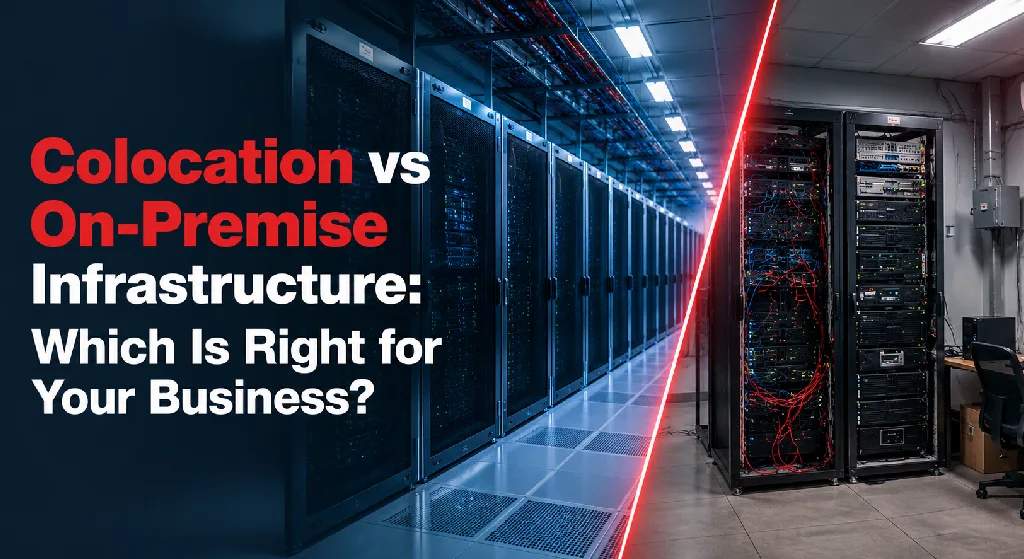
This is where the debate between colocation vs on-premise infrastructure becomes relevant.
Both models allow businesses to own and control their hardware, but they differ significantly in terms of cost, security, scalability, and reliability.
Understanding these differences can help you choose the right long-term strategy for your organization.
Understanding Both Models
Before comparing the two options, it’s important to understand how each works.
What Is On-Premise Infrastructure?
On-premise infrastructure refers to servers, storage systems, and networking equipment housed within your own facility.
This may include:
- Server closets
- Dedicated server rooms
- Corporate data centers
- Office-based IT environments
The business is responsible for everything, including:
- Power
- Cooling
- Physical security
- Connectivity
- Hardware maintenance
- Facility management
Many organizations start with on-prem infrastructure because it provides complete control and immediate access to equipment.
What Is Colocation?
Colocation allows businesses to place their own hardware inside a third-party data center facility.
The business continues to own and manage:
- Servers
- Storage systems
- Firewalls
- Network equipment
- Applications
The colocation provider manages:
- Power infrastructure
- Cooling systems
- Physical security
- Building operations
- Network connectivity options
Colocation offers many of the benefits of a data center without requiring businesses to build and maintain one themselves.
Colocation allows businesses to place their own hardware inside a third-party data center facility.
Learn More: What colocation is and how it works
Cost Comparison
Cost is often one of the biggest factors when evaluating infrastructure options.
On-Premise Costs
Many organizations underestimate the true cost of maintaining infrastructure internally.
Common expenses include:
- Server room construction
- Power upgrades
- Cooling systems
- Backup generators
- Security systems
- Internet connectivity
- Equipment monitoring
- Facility maintenance
These expenses often increase as infrastructure grows.
In addition, businesses remain responsible for replacing aging facility infrastructure over time.
Colocation Costs
Colocation pricing is generally based on:
- Rack space
- Power usage
- Bandwidth requirements
- Support services
Organizations evaluating the financial impact of each option can review how much colocation costs to better understand pricing factors and ongoing expenses.
Instead of investing heavily in facility infrastructure, businesses pay a predictable monthly fee.
Which Is More Cost-Effective?
For very small environments, on-prem infrastructure may initially appear less expensive.
However, as requirements increase, many organizations discover that maintaining enterprise-grade power, cooling, and security internally becomes significantly more costly than colocating equipment.
The larger and more critical your infrastructure becomes, the more favorable colocation often looks from a financial perspective.
Security Comparison
Security extends beyond cybersecurity. Physical protection of infrastructure is equally important.
On-Premise Security
Most offices are not designed to function as secure data centers.
Common limitations include:
- Shared building access
- Limited monitoring
- Minimal access controls
- Lack of dedicated security personnel
- Environmental vulnerabilities
While organizations can improve security, doing so often requires significant investment.
Colocation Security
Professional data centers are purpose-built for infrastructure protection.
Typical security measures include:
- 24/7 monitoring
- Video surveillance
- Biometric access controls
- Multi-factor authentication
- Secure visitor procedures
- Locked cabinets and cages
Organizations concerned about infrastructure protection can explore how secure colocation is and how colocation security works to understand the security advantages of professional facilities.
Many facilities also support compliance requirements for regulated industries.
Security Advantage
For most businesses, colocation provides a substantially higher level of physical security than a typical office environment.
Scalability Comparison
Technology needs rarely remain static.
The ability to scale efficiently is a critical consideration.
On-Premise Scalability
Growth often requires:
- Additional rack space
- Electrical upgrades
- Cooling enhancements
- Network improvements
- Physical renovations
These projects can be expensive and disruptive.
Eventually, some organizations reach the physical limits of their facility.
Colocation Scalability
Colocation facilities are designed for expansion.
Businesses can typically add:
- Rack units
- Full cabinets
- Additional power
- More bandwidth
- Private cages
- Dedicated suites
Without relocating infrastructure or renovating facilities.
Organizations planning long-term growth should also understand what to look for in a colocation provider to ensure their chosen facility can support future expansion.
Scalability Advantage
Colocation generally offers far greater flexibility and room for growth.
Organizations can scale infrastructure as business requirements evolve without major capital projects.
Reliability Comparison
Infrastructure reliability directly affects productivity, customer experience, and revenue.
On-Premise Reliability
Most office environments rely on:
- Single utility power feeds
- Standard HVAC systems
- Limited backup power
- Single internet providers
While these systems may work well under normal conditions, they often lack redundancy.
A power outage, cooling failure, or network disruption can create significant downtime.
Colocation Reliability
Data centers are engineered for continuous operation.
Common features include:
- Redundant power systems
- UPS protection
- Backup generators
- Multiple cooling systems
- Diverse network providers
- Continuous infrastructure monitoring
These safeguards dramatically reduce operational risk.
Reliability Advantage
For businesses that depend heavily on technology, colocation typically delivers a significantly higher level of uptime and resilience.
Comparing Colocation and On-Premise Infrastructure
| Factor | On-Premise Infrastructure | Colocation |
| Hardware Ownership | Business-owned | Business-owned |
| Facility Management | Business responsibility | Provider responsibility |
| Physical Security | Varies by facility | Enterprise-grade security |
| Power Redundancy | Often limited | Multiple redundant systems |
| Cooling Infrastructure | Business-managed | Professionally managed |
| Scalability | Facility-dependent | Highly scalable |
| Connectivity Options | Often limited | Carrier-neutral options available |
| Disaster Recovery Readiness | Varies significantly | Stronger infrastructure support |
| Upfront Capital Costs | High | Lower |
| Monthly Operational Costs | Variable | Predictable |
Which Option Fits Different Business Types?
The right choice depends on your organization’s size, growth plans, and operational requirements.
On-Premise May Be Suitable For:
- Small businesses with minimal infrastructure
- Organizations requiring constant physical access to equipment
- Businesses with existing data center investments
- Specialized environments with unique hardware requirements
Colocation May Be Better For:
- Growing organizations
- Multi-location businesses
- Healthcare providers
- Financial institutions
- Manufacturers
- Technology companies
- Businesses with uptime-sensitive applications
- Organizations planning future expansion
Small and mid-sized organizations can also evaluate whether colocation is right for small and mid-sized businesses when deciding whether moving away from traditional server rooms makes sense.
Common Transition Point
Many companies start with on-prem infrastructure and eventually migrate to colocation as:
- Equipment grows
- Downtime risks increase
- Compliance requirements expand
- Business continuity becomes more important
For organizations deciding between building their own facility or using a third-party provider, build vs colocate is an important comparison to consider.
This progression is a natural part of IT maturity for many organizations.
Questions to Ask Before Deciding
- How quickly are infrastructure requirements changing?
- Does operating infrastructure create competitive advantage?
- Are facility responsibilities increasing?
- How much internal effort supports infrastructure today?
- What would growth require operationally?
- Does recovery planning affect the decision?
Organizations comparing providers may also want to review questions to ask before signing with a data center before making a long-term commitment.
Common Mistakes When Comparing the Two
Mistake 1: Optimizing for current requirements only.
Mistake 2: Comparing pricing without operational costs.
Mistake 3: Assuming ownership equals flexibility.
Mistake 4: Ignoring disaster recovery implications.
Mistake 5: Treating infrastructure as static.
Final Thoughts
The decision between colocation and on-premise infrastructure is ultimately a balance between control, cost, scalability, and reliability.
While on-prem infrastructure can work well for smaller deployments, growing organizations often face increasing challenges related to power, cooling, security, and expansion.
Colocation offers a practical alternative by providing enterprise-grade infrastructure without the expense and complexity of building a private data center.
Businesses exploring professional infrastructure solutions can review Sierra Data Centers and their colocation services to understand available options.
For businesses seeking greater uptime, stronger security, improved scalability, and predictable operational costs, colocation often provides a more sustainable long-term solution.
If you are evaluating whether colocation is the right move for your organization, you can contact Sierra Data Centers to discuss your infrastructure requirements.