When organizations develop disaster recovery plans, one of the most important questions they must answer is:
“How quickly do we need our systems back online?”
The answer to that question is known as the Recovery Time Objective (RTO).
RTO is one of the foundational concepts of disaster recovery and business continuity planning. It helps organizations determine how much downtime they can tolerate and guides decisions around backups, infrastructure investments, disaster recovery sites, and recovery strategies.
Without clearly defined recovery objectives, businesses may struggle to prioritize resources, manage downtime, and recover effectively during an outage.
In this guide, we’ll explain what Recovery Time Objective means, how it differs from Recovery Point Objective (RPO), how organizations calculate RTO, and how data centers support faster recovery.
What Is Recovery Time Objective (RTO)?
Recovery Time Objective (RTO) is the maximum amount of time a business can tolerate a system, application, or service being unavailable after a disruption.
In simple terms:
RTO answers the question: “How long can we be down?”
Once the RTO threshold is exceeded, the business begins experiencing unacceptable operational, financial, or reputational impacts.
Example
Imagine an organization determines that its customer portal must be restored within four hours of an outage.
In this scenario:
RTO = 4 hours
If recovery takes longer than four hours, the business may experience unacceptable consequences such as:
- Lost revenue
- Customer dissatisfaction
- Compliance issues
- Operational disruption
The shorter the RTO, the more sophisticated and resilient the recovery solution typically needs to be.
Why RTO Matters
Recovery objectives help organizations make informed decisions about disaster recovery planning.
Without a defined RTO:
- Recovery priorities become unclear.
- Technology investments become difficult to justify.
- Recovery performance cannot be measured.
- Business continuity planning becomes inconsistent.
RTO provides a measurable target that guides recovery efforts.
RTO Influences
Recovery Time Objectives impact decisions involving:
- Backup systems
- Disaster recovery sites
- Data replication
- Network redundancy
- Infrastructure design
- Business continuity investments
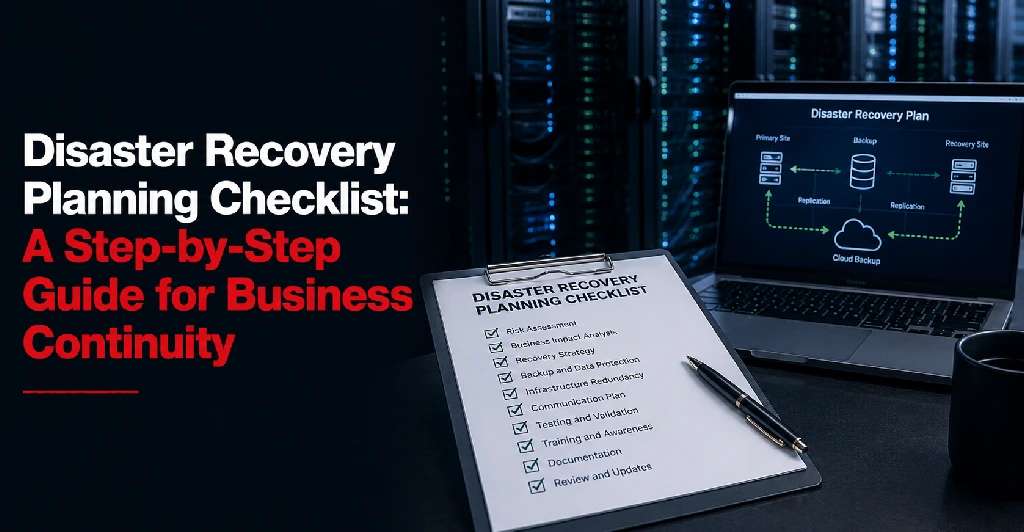
Organizations with aggressive recovery requirements generally require more robust recovery environments. Building these objectives into a structured disaster recovery planning checklist helps ensure recovery capabilities align with business requirements.
RTO vs RPO: What’s the Difference?
Recovery Time Objective (RTO) and Recovery Point Objective (RPO) are often discussed together, but they measure different aspects of recovery.
Recovery Time Objective (RTO)
RTO measures:
How long systems can remain unavailable.
Examples:
- 15 minutes
- 1 hour
- 4 hours
- 24 hours
RTO focuses on downtime.
Recovery Point Objective (RPO)
RPO measures:
How much data loss is acceptable.
Examples:
- Zero data loss
- 15 minutes of lost data
- One hour of lost data
- One day of lost data
RPO focuses on data recovery.
Simple Example
Suppose a company’s online ordering platform experiences an outage.
Recovery requirements might be:
- RTO: 2 hours
- RPO: 15 minutes
This means:
- The system must be restored within two hours.
- No more than 15 minutes of data can be lost.
Both objectives work together to define recovery expectations.
It’s also important to understand that achieving aggressive RTO and RPO targets often requires more than traditional backups. Understanding the difference between disaster recovery and backup can help organizations choose the right recovery strategy.
How Businesses Calculate RTO
There is no universal RTO that works for every organization.
Recovery objectives should be based on business impact rather than technical preferences.
Step 1: Identify Critical Systems
Begin by identifying:
- Business applications
- Customer-facing systems
- Financial systems
- Communication platforms
- Infrastructure services
Not every system requires the same recovery speed.
Step 2: Evaluate Business Impact
Ask questions such as:
- How much revenue is lost during downtime?
- How many employees are affected?
- Are customers impacted?
- Are compliance requirements involved?
The answers help determine acceptable downtime thresholds.
Step 3: Prioritize Systems
Most organizations categorize systems into tiers.
Tier 1: Mission-Critical
Examples:
- Customer portals
- Financial systems
- Healthcare applications
Typical RTO:
- Minutes to a few hours
Tier 2: Business-Critical
Examples:
- ERP systems
- Internal applications
- Collaboration platforms
Typical RTO:
- Several hours
Tier 3: Non-Critical
Examples:
- Archive systems
- Development environments
- Historical reporting systems
Typical RTO:
- One or more days
Step 4: Align Recovery Capabilities
Recovery infrastructure must be capable of meeting established objectives.
If your RTO is one hour, your recovery environment must support recovery within that timeframe.
RTO Examples by Industry
Different industries have different recovery requirements.
Healthcare
Healthcare organizations often support:
- Electronic medical records
- Patient scheduling
- Clinical systems
Typical RTO:
- Less than one hour to several hours
Patient care can be directly affected by system outages.
Financial Services
Banks and financial institutions rely heavily on system availability.
Typical RTO:
- Minutes to a few hours
Extended downtime may impact transactions, customer access, and regulatory obligations.
Manufacturing
Manufacturers increasingly depend on connected production systems.
Typical RTO:
- Several hours
Downtime can disrupt production schedules and supply chains.
E-Commerce
Online retailers rely on continuous platform availability.
Typical RTO:
- Minutes to a few hours
Every minute of downtime may impact revenue.
Professional Services
Professional service firms often have more flexible recovery requirements.
Typical RTO:
- Several hours to one day
Recovery priorities depend on client obligations and operational needs.
Common RTO Mistakes
Many organizations struggle to establish realistic recovery objectives.
Setting Unrealistic Expectations
Some businesses define aggressive recovery targets without understanding the infrastructure required to achieve them.
For example:
- A 15-minute RTO often requires significantly more investment than a 4-hour RTO.
Recovery goals should align with available resources.
Applying One RTO to Every System
Not every application requires immediate recovery.
Using the same RTO for all systems often leads to unnecessary costs.
Ignoring Business Stakeholders
Recovery objectives should involve both IT and business leadership.
Technology teams alone may not fully understand operational impacts.
Failing to Test Recovery Times
Many organizations establish RTOs but never verify whether they can actually meet them.
Testing is essential for validating recovery capabilities. Regular disaster recovery testing helps confirm that established recovery targets are achievable.
Not Updating RTOs
As businesses grow and technology evolves, recovery requirements often change.
Recovery objectives should be reviewed regularly.
Organizations should also avoid many of the pitfalls covered in our guide to common disaster recovery mistakes, which can negatively impact recovery performance.
How Data Centers Support Faster Recovery
Professional data centers play an important role in helping organizations achieve recovery objectives.
Disaster Recovery Sites
Many facilities offer:
- Hot sites
- Warm sites
- Cold sites
These environments support faster recovery during outages. Businesses evaluating recovery infrastructure should understand the role of a disaster recovery site and how different deployment models affect recovery times.
Reliable Infrastructure
Professional data centers provide:
- Redundant power systems
- Backup generators
- Advanced cooling
- Physical security
These features reduce the likelihood of prolonged disruptions.
Connectivity Redundancy
Carrier-neutral facilities support:
- Multiple network providers
- Diverse network paths
- Automatic failover
Reliable connectivity helps maintain access to critical systems.
Data Replication
Many disaster recovery environments support:
- Real-time replication
- Frequent synchronization
- Automated recovery processes
These capabilities improve both RTO and RPO performance.
Scalable Recovery Solutions
As recovery requirements evolve, businesses can expand infrastructure without rebuilding their disaster recovery strategy from scratch.
Organizations often leverage specialized disaster recovery solutions to support changing recovery requirements and business growth.
Questions to Ask About Recovery Objectives
When evaluating disaster recovery capabilities, consider asking:
- What RTO can our current infrastructure realistically support?
- Have recovery times been tested recently?
- Which systems require the fastest recovery?
- Can our disaster recovery site meet recovery objectives?
- Does our network infrastructure support rapid recovery?
- How frequently are recovery procedures validated?
These questions help ensure recovery plans align with business expectations.
Final Thoughts
Recovery Time Objective (RTO) is one of the most important metrics in disaster recovery planning.
By defining how quickly critical systems must be restored after an outage, RTO helps organizations prioritize investments, design recovery strategies, and measure recovery performance.
The right RTO depends on business requirements, operational impact, and risk tolerance. While some applications may require near-instant recovery, others can tolerate longer downtime.
Organizations that clearly define, test, and regularly review their recovery objectives are better positioned to minimize disruption and maintain business continuity when unexpected events occur.
In today’s always-on business environment, understanding and planning around RTO is not just an IT responsibility—it’s a business necessity.
To learn more about business continuity and recovery infrastructure, explore Sierra Data Centers’ data center solutions or contact our team to discuss your recovery requirements.