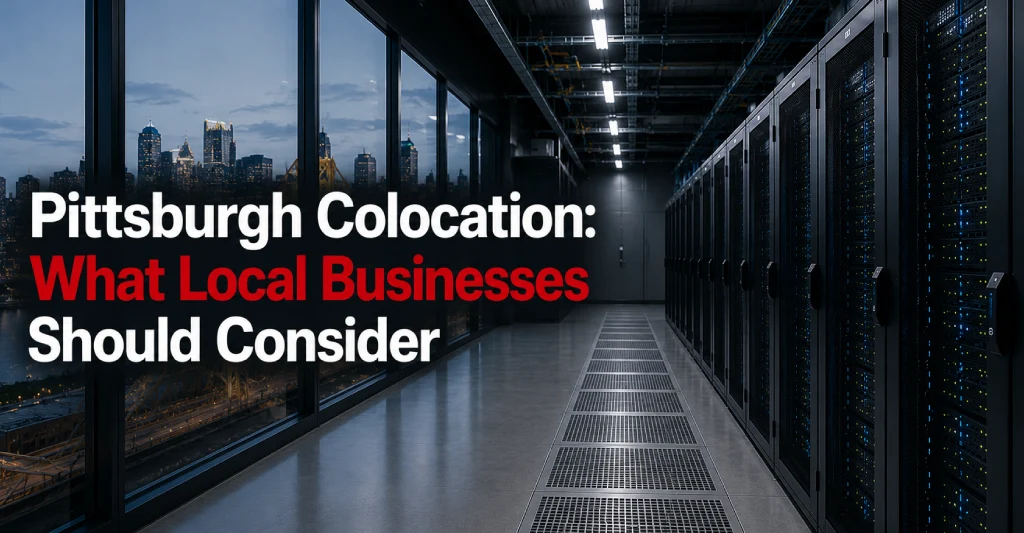
For many Pittsburgh-area businesses, infrastructure has become too important to leave in an office server room, IT closet, or aging on-premise environment. Servers, storage, firewalls, backup systems, and network equipment often support daily operations, customer access, internal applications, compliance needs, and business continuity.
Colocation gives businesses a way to keep control of their own infrastructure while placing it inside a professional data center environment.
Instead of hosting equipment in an office building, businesses can move servers into a secure facility designed for power, cooling, physical security, connectivity, monitoring, and long-term scalability.
For companies in Pittsburgh and the surrounding region, choosing a local or regional colocation provider can offer a practical balance of reliability, accessibility, and infrastructure control.
What Is Pittsburgh Colocation?
Pittsburgh colocation refers to placing business-owned servers, storage, network equipment, and related infrastructure inside a data center facility serving the Pittsburgh region.
The business continues to own or manage its equipment. The data center provides the facility environment, which may include:
- Secure rack space
- Full cabinets
- Private cages
- Private suites
- Redundant power
- Dedicated cooling
- Physical security
- Carrier-neutral connectivity
- Remote hands support
- Environmental monitoring
- Disaster recovery support
Colocation is useful for businesses that want more reliability than an office server room but do not want to move every workload fully into cloud infrastructure. This falls under broader colocation services.
Why Pittsburgh Businesses Choose Colocation
Pittsburgh businesses may choose colocation for several reasons.
Common reasons include:
- Office server room limitations
- Aging infrastructure environments
- Power reliability concerns
- Cooling limitations
- Need for stronger physical security
- Need for better connectivity
- Growth beyond current rack space
- Backup and disaster recovery planning
- Compliance or audit requirements
- Multi-location infrastructure needs
- Desire to keep physical control over equipment
Colocation can help local businesses reduce infrastructure risk while keeping important systems within practical regional reach.
For companies that rely on servers for daily operations, moving to a data center can be a major step toward better uptime and business continuity.
Office Server Rooms Create Hidden Risk
Many businesses start with equipment hosted inside their own office. This may work when the infrastructure is small, but it can become risky as the business grows.
Office server rooms often have limitations such as:
- Standard building power
- Limited backup power
- No generator support
- Office-grade cooling
- Poor airflow
- Weak physical access control
- Limited environmental monitoring
- Single internet provider dependency
- Limited fire protection for IT equipment
- No on-site remote hands support
- Limited room for expansion
These risks may not be obvious until something goes wrong.
A power outage, cooling failure, accidental disconnection, internet issue, or building event can interrupt important systems quickly.
Colocation helps move infrastructure into a purpose-built environment designed to reduce these risks, an important consideration outlined in what to look in a secure data center facility.
Local Access Still Matters
One of the benefits of regional colocation is accessibility to a nearby Pittsburgh data center. Even with remote management tools, businesses may occasionally need physical access to equipment for:
- Hardware installation
- Equipment replacement
- Network changes
- Vendor maintenance
- Cabling work
- Audit review
- Emergency troubleshooting
- Infrastructure migration
- Equipment removal
- Expansion planning
A regional data center can be easier to access than a distant facility.
This does not mean your IT team needs to visit frequently. Remote hands support can handle many physical tasks. But when direct access is needed, a local or regional facility can reduce travel time and operational friction.
Colocation vs Cloud for Pittsburgh Businesses
Colocation and cloud are not the same, and one does not always replace the other.
Cloud can be useful for flexible workloads, SaaS applications, development environments, and scalable services.
Colocation may be a better fit when a business needs:
- Control over physical hardware
- Specific server configurations
- Existing infrastructure investment
- Predictable infrastructure design
- Private network equipment
- Legacy applications
- Compliance-driven control
- Low-latency regional access
- Backup or disaster recovery infrastructure
- Hybrid cloud architecture
Many businesses use both. A Pittsburgh company may keep certain systems in colocation, use cloud services for collaboration, and maintain backups or recovery infrastructure in a data center.
The best strategy depends on the application, budget, security requirements, and operational needs.
Colocation vs On-Premise Infrastructure
Colocation gives businesses more professional infrastructure conditions than most on-premise environments. Compared with an office server room, a dedicated data center facility can provide:
- Better physical security
- Redundant power options
- Dedicated cooling
- Environmental monitoring
- Carrier-neutral connectivity
- More reliable rack space
- Remote hands support
- Private cage or suite options
- Better disaster recovery support
- More scalable infrastructure planning
The business still keeps control of its own hardware and systems, but the facility environment is stronger.
For many Pittsburgh businesses, this is the main appeal of colocation. It improves the infrastructure foundation without forcing a full cloud migration.
RELATED: Colocation vs On-Premise Infrastructure: Which Is Right for Your Business?
Security Considerations for Pittsburgh Colocation
Security should be one of the first areas businesses evaluate.
A secure colocation facility should provide layered physical security from the building entrance to the rack, cage, or suite.
Businesses should ask about:
- Facility access control
- Visitor check-in procedures
- Vendor escorting
- Security cameras
- Access logs
- Locked cabinets
- Private cage options
- Private suite options
- Remote hands authorization
- Emergency access procedures
Security is especially important for businesses in healthcare, financial services, manufacturing, legal services, insurance, technology, and enterprise environments.
A secure facility should help reduce unauthorized physical access and provide documentation around access procedures.
Rack Space and Growth Planning
Before choosing colocation, Pittsburgh businesses should understand how much rack space their business needs.
Rack space planning should include:
- Servers
- Storage systems
- Firewalls
- Switches
- Routers
- Backup appliances
- Patch panels
- Cable management
- Power distribution
- Spare hardware
- Future expansion
A business may start with partial rack space, a full cabinet, or multiple racks. As infrastructure grows, a private cage or suite may become more appropriate, and it helps to know when to move from a shared rack to a private cage.
The right colocation provider should help businesses plan for both current equipment and future growth.
Choosing too little space may create another migration later.
Power Redundancy
Power is one of the most important reasons businesses move infrastructure into a data center.
A Pittsburgh colocation provider should be evaluated for power reliability, including:
- Utility power design
- UPS systems
- Battery backup
- Backup generators
- Power distribution
- A and B power feeds
- Rack-level power capacity
- Power monitoring
- Maintenance procedures
- SLA commitments
Businesses should also review their own equipment. Servers, firewalls, switches, and storage systems with dual power supplies can better use redundant power feeds.
Power Redundancy should be planned from the facility level down to the rack and equipment level.
Cooling and Environmental Controls
Servers and network equipment generate heat. Without proper cooling, systems can become unstable, slow down, shut down, or fail.
A professional data center should provide:
- Dedicated cooling systems
- Temperature monitoring
- Humidity control
- Cooling redundancy
- Airflow management
- Hot aisle and cold aisle planning
- Environmental alerts
- Backup power for cooling systems
Cooling should be reviewed alongside rack density and power requirements — see data center cooling explained for more details.
If a business is moving equipment from an office server room, cooling is often one of the biggest improvements colocation can provide.
Carrier-Neutral Connectivity
Connectivity is a major factor when choosing Pittsburgh colocation.
A carrier-neutral data center gives businesses access to multiple network providers instead of limiting them to one carrier through robust connectivity solutions.
This can support:
- Redundant internet connections
- Better failover planning
- Private network connections
- Cross-connects
- Cloud connectivity
- Branch office connectivity
- Vendor connectivity
- Reduced single-carrier dependency
For businesses with multiple offices, remote workers, or customer-facing applications, connectivity planning is essential.
A secure facility is not enough if users cannot reliably reach the systems hosted there.
Network Redundancy
Network redundancy helps reduce the risk that one carrier, circuit, router, or connection problem interrupts access to hosted infrastructure.
Pittsburgh businesses should review:
- Number of available carriers
- Redundant internet options
- Diverse network paths
- Cross-connect availability
- VPN requirements
- Firewall placement
- Cloud connectivity
- Branch office connectivity
- Network failover planning
Connectivity should be designed around the business’s data center uptime and redundancy needs.
For multi-location businesses, branch access to data center-hosted systems should be part of the planning process.
Remote Hands Support
Remote hands support allows data center technicians to perform approved physical tasks on customer equipment.
This may include:
- Checking equipment status
- Rebooting servers
- Verifying cables
- Installing patch cables
- Replacing hardware
- Receiving equipment
- Escorting vendors
- Supporting migrations
- Assisting during incidents
Remote hands support is valuable because it can reduce the need for emergency travel to the facility.
Pittsburgh businesses should ask:
- Is remote hands support available?
- Is after-hours support available?
- What tasks are included?
- What tasks are excluded?
- How are requests authorized?
- Are activities documented?
- Can technicians provide updates or photos?
- How are emergency requests handled?
Remote hands can make colocation easier to manage, especially for lean IT teams.
Disaster Recovery and Backup Infrastructure
Colocation can support resilience strategies by providing a secure, off-site environment for disaster recovery solutions. Pittsburgh businesses may use colocation for:
- Backup servers
- Replication targets
- Disaster recovery appliances
- Recovery network equipment
- Standby infrastructure
- Offsite storage
- Failover systems
Disaster recovery planning should define:
- Critical systems
- Recovery time objective
- Recovery point objective
- Backup frequency
- Recovery order
- Testing schedule
- Communication process
- Roles and responsibilities
A regional colocation facility can provide separation from the primary office while remaining accessible for support and maintenance.
Colocation for Healthcare Organizations in Pittsburgh
Healthcare organizations need secure, available infrastructure for systems such as patient records, scheduling, billing, imaging, communication, backups, and recovery.
Pittsburgh colocation can support infrastructure for healthcare organizations with:
- Secure infrastructure space
- Access control
- Private rack, cage, or suite options
- Redundant power
- Cooling reliability
- Backup infrastructure
- Disaster recovery support
- Carrier-neutral connectivity
- Remote hands support
- Documentation support
Healthcare organizations should still manage their own compliance obligations, applications, data access, and security controls, as outlined further in HIPAA compliant data center hosting.
Colocation for Financial Services Companies in Pittsburgh
Financial services companies often need reliable infrastructure for customer data, internal applications, reporting, document systems, communication, and continuity planning.
Pittsburgh colocation can help the infrastructure for financial services firms improve:
- Physical security
- Access control
- Network redundancy
- Backup hosting
- Disaster recovery planning
- Private infrastructure space
- SLA-based infrastructure review
- Regional support access
Financial organizations should evaluate access logs, provider documentation, remote hands procedures, power redundancy, connectivity options, and SLA terms.
Colocation for Manufacturers in Pittsburgh
Manufacturing businesses rely on infrastructure for ERP systems, inventory, logistics, production schedules, finance systems, vendor coordination, and multi-location access.
Pittsburgh colocation can support infrastructure for manufacturing by providing:
- Central infrastructure hosting
- Plant and warehouse connectivity
- Backup systems
- Disaster recovery infrastructure
- Redundant power
- Dedicated cooling
- Carrier-neutral connectivity
- Remote hands support
- Private cage options
For manufacturers, infrastructure reliability supports operational continuity.
If ERP, inventory, or scheduling systems become unavailable, production and logistics can be affected.
Colocation for Multi-Location Businesses
Businesses with multiple offices, clinics, plants, warehouses, or branches need reliable access to central systems.
A Pittsburgh colocation environment may support:
- Centralized applications
- Secure remote access
- Branch office connectivity
- Shared file systems
- Backup infrastructure
- Disaster recovery
- Network equipment
- Cloud connectivity
- Vendor access
For multi-location businesses, colocation planning should include connectivity, redundancy, bandwidth, and failover strategy, and reviewing how to choose data center for multi-location businesses can help.
Compliance and Documentation
Some Pittsburgh businesses need data center environments that support compliance readiness.
This may apply to healthcare, financial services, manufacturing, legal, insurance, enterprise, and technology companies.
A colocation provider can support compliance efforts through:
- Physical access controls
- Visitor management
- Vendor procedures
- Rack, cage, or suite security
- Access logs
- Remote hands authorization
- Facility documentation
- SLA documentation
- Power and cooling information
- Incident communication procedures
A data center does not automatically make a business compliant. However, the right facility can provide a stronger physical and operational foundation, as outlined in a data center compliance checklist.
Migration Planning for Pittsburgh Colocation
Moving infrastructure into a colocation facility should be planned carefully.
Before migration, businesses should review:
- Equipment inventory
- Application dependencies
- Critical systems
- Rack space requirements
- Power needs
- Cooling requirements
- Connectivity needs
- Backup status
- Downtime tolerance
- Vendor coordination
- Access procedures
- Testing plan
- Rollback plan
The migration should not be treated as a simple equipment move.
Servers, applications, databases, firewalls, storage, backups, users, and vendors may all depend on each other. Planning reduces the chance of disruption.
What to Ask a Pittsburgh Colocation Provider
Before choosing a provider, ask:
- What rack space options are available?
- Are full cabinets, private cages, or suites available?
- What power redundancy is in place?
- Are A and B power feeds available?
- What cooling systems are used?
- Is temperature and humidity monitored?
- Is the facility carrier-neutral?
- What network carriers are available?
- Are cross-connects supported?
- What remote hands support is available?
- How is facility access controlled?
- Are access logs available?
- How are visitors and vendors handled?
- What disaster recovery options are supported?
- What does the SLA cover?
- How are incidents communicated?
- Can the facility support future growth?
These questions help businesses compare providers beyond price and available rack space.
Pittsburgh Colocation Checklist
When evaluating Pittsburgh colocation, review:
- Facility location
- Physical security
- Access control
- Visitor and vendor procedures
- Rack space options
- Full cabinet availability
- Private cage availability
- Private suite availability
- Power redundancy
- Cooling redundancy
- Environmental monitoring
- Carrier-neutral connectivity
- Network redundancy
- Cross-connect options
- Remote hands support
- Backup infrastructure support
- Disaster recovery support
- SLA commitments
- Compliance documentation
- Migration support
- Future expansion capacity
This checklist helps businesses choose a colocation environment that supports reliability, security, and growth.
Common Colocation Mistakes to Avoid
Pittsburgh businesses should avoid common colocation mistakes such as:
- Choosing based only on price
- Waiting until the office server room fails
- Underestimating rack space needs
- Ignoring power requirements
- Ignoring cooling requirements
- Depending on one carrier
- Not testing backups
- Not planning disaster recovery
- Not reviewing access control procedures
- Not asking about remote hands support
- Not reviewing SLA terms
- Not planning for future growth
- Treating migration as a simple equipment move
Most of these mistakes can be avoided with early planning and the right provider evaluation process.
Is Pittsburgh Colocation Right for Your Business?
Pittsburgh colocation may be a strong fit if your business:
- Runs critical systems on physical servers
- Has outgrown an office server room
- Needs better power and cooling
- Wants stronger physical security
- Needs carrier-neutral connectivity
- Requires backup or disaster recovery infrastructure
- Wants to keep control over hardware
- Has compliance or documentation needs
- Supports multiple locations
- Needs room for infrastructure growth
Colocation gives businesses a way to improve reliability while maintaining control over infrastructure.
Plan Pittsburgh Colocation With Sierra Data Centers
Sierra Data Centers supports Pittsburgh-area businesses with secure colocation, data center hosting, private cages, private suites, carrier-neutral connectivity, remote hands support, and disaster recovery planning.
For organizations moving from office server rooms, expanding infrastructure, planning backup environments, or evaluating private rack and cage options, Sierra Data Centers can help assess rack space, power, cooling, connectivity, access control, and long-term growth needs.
If your business is reviewing Pittsburgh colocation options, contact us to plan a secure and reliable data center environment.