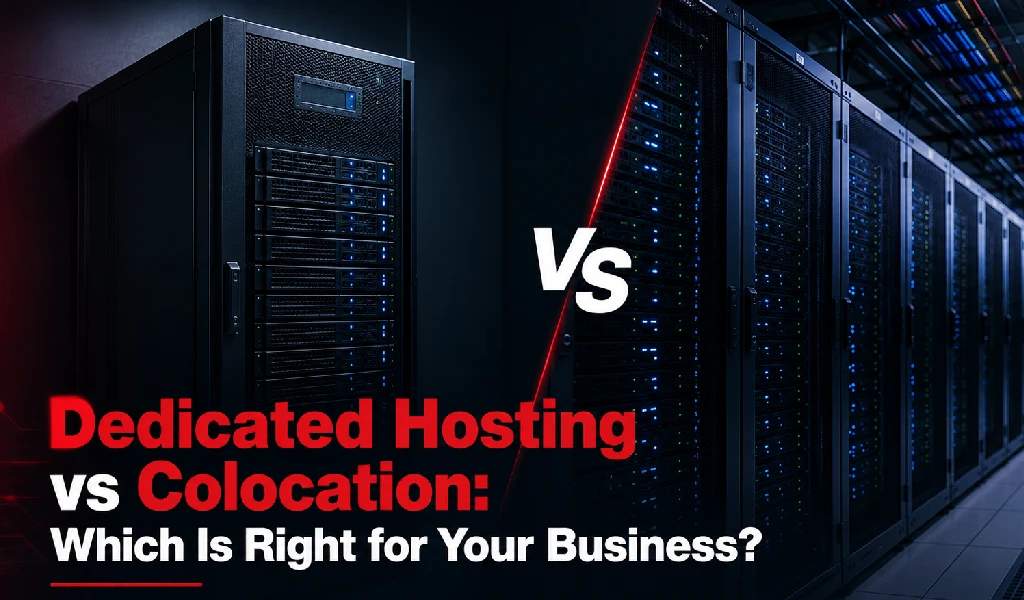
When evaluating infrastructure options, many organizations find themselves comparing dedicated hosting vs colocation. Both solutions provide access to enterprise-grade data center environments, reliable connectivity, and enhanced security. However, they differ significantly in terms of ownership, management responsibilities, costs, and operational flexibility.
Choosing the right model depends on your business goals, IT resources, compliance requirements, and long-term growth plans.
In this guide, we’ll compare dedicated hosting and colocation to help determine which option best fits your organization’s needs.
What Is Dedicated Hosting?
Dedicated hosting is a service where a provider supplies and maintains physical servers that are used exclusively by a single customer.
Unlike shared hosting environments, dedicated hosting gives businesses access to server resources that are not shared with other organizations.
The hosting provider typically manages:
- Physical hardware
- Data center infrastructure
- Power and cooling
- Network connectivity
- Hardware maintenance
Depending on the service agreement, providers may also offer managed services such as:
- Operating system management
- Monitoring
- Security updates
- Backup services
- Technical support
With dedicated hosting, businesses gain access to enterprise-grade infrastructure without purchasing or maintaining their own hardware.
Organizations comparing hosting models can also review what is data center hosting to understand how professional hosting environments support business applications and infrastructure.
Benefits of Dedicated Hosting
Organizations often choose dedicated hosting because it offers:
Faster Deployment
Infrastructure is already available and can often be deployed quickly.
Reduced Capital Investment
There is no need to purchase servers, racks, or supporting hardware.
Simplified Management
The provider handles hardware maintenance and replacement.
Predictable Costs
Monthly service fees often include infrastructure and support costs.
Enterprise Infrastructure Access
Businesses benefit from professional data center facilities without managing the underlying environment.
What Is Colocation?
Colocation allows businesses to place their own servers and IT equipment inside a third-party data center.
The business owns and manages:
- Servers
- Storage systems
- Networking equipment
- Security appliances
- Software and applications
The colocation provider supplies:
- Rack space
- Power
- Cooling
- Physical security
- Connectivity infrastructure
Colocation gives organizations full control over their hardware while leveraging the reliability and security of a professional data center.
Businesses evaluating colocation options can explore colocation services to understand how professional facilities support customer-owned infrastructure.
Benefits of Colocation
Many businesses choose colocation because it provides:
Complete Hardware Control
Organizations can select and configure hardware based on their exact requirements.
Greater Customization
Infrastructure can be tailored to specific workloads and compliance needs.
Long-Term Asset Ownership
Businesses retain ownership of equipment and infrastructure investments.
Flexible Technology Strategy
Organizations are not limited to hardware options offered by a hosting provider.
Enterprise Data Center Benefits
Businesses gain access to professional facilities without building their own data center.
Ownership Differences
One of the biggest distinctions between dedicated hosting and colocation is ownership.
Dedicated Hosting Ownership Model
With dedicated hosting:
- The provider owns the servers.
- The provider replaces failed hardware.
- Infrastructure lifecycle management is handled by the provider.
The customer essentially rents server resources.
Colocation Ownership Model
With colocation:
- The customer owns the hardware.
- The customer selects equipment specifications.
- The customer manages hardware refresh cycles.
The business retains full control over infrastructure decisions.
Why Ownership Matters
Ownership affects:
- Technology flexibility
- Hardware customization
- Budget planning
- Asset management
- Long-term infrastructure strategy
Organizations that require specialized equipment often prefer colocation, while businesses seeking simplicity may favor dedicated hosting.
Cost Differences
Cost structures differ significantly between the two models.
Dedicated Hosting Costs
Dedicated hosting typically involves:
- Monthly service fees
- Infrastructure rental costs
- Optional managed service fees
There is little or no upfront hardware investment.
This makes dedicated hosting attractive for organizations seeking predictable operational expenses.
Colocation Costs
Colocation generally includes:
- Hardware purchases
- Rack space fees
- Power costs
- Bandwidth charges
- Optional support services
Although upfront investments are higher, businesses may reduce long-term infrastructure costs by owning equipment.
Which Is More Cost-Effective?
The answer depends on business requirements.
Dedicated hosting often works well when:
- Infrastructure needs are modest
- Rapid deployment is important
- Capital expenditure budgets are limited
Colocation may offer better long-term value when:
- Infrastructure requirements are substantial
- Hardware will be utilized for several years
- Customization is important
- Organizations have internal IT expertise
Security Considerations
Both dedicated hosting and colocation benefit from the security of professional data center environments.
However, security responsibilities differ.
Dedicated Hosting Security
The provider typically manages:
- Physical infrastructure security
- Hardware maintenance
- Certain operating system and infrastructure controls
Depending on the service agreement, the provider may also handle some cybersecurity responsibilities.
Colocation Security
The provider secures:
- The facility
- Power systems
- Cooling infrastructure
- Physical access controls
The customer remains responsible for:
- Server security
- Network security
- Operating systems
- Application security
Businesses looking for additional guidance on infrastructure protection can review what makes a secure hosting environment when evaluating security requirements.
Which Is More Secure?
Neither model is inherently more secure.
The better choice depends on how much control and responsibility your organization wants to maintain.
Businesses with strong internal IT teams often prefer the flexibility of colocation, while organizations seeking reduced management responsibilities may prefer dedicated hosting.
Scalability and Growth
As businesses grow, infrastructure requirements often change.
Dedicated Hosting Scalability
Scaling usually involves:
- Adding servers
- Upgrading service plans
- Expanding hosting resources
The provider handles deployment and hardware procurement.
Colocation Scalability
Scaling may involve:
- Installing additional servers
- Expanding rack space
- Increasing power capacity
- Adding bandwidth
Organizations maintain complete control over expansion decisions.
Which Offers Greater Flexibility?
Colocation generally provides greater flexibility for organizations with specialized requirements.
Dedicated hosting often provides faster and simpler scaling for businesses focused on operational efficiency.
Comparing Dedicated Hosting and Colocation
| Factor | Dedicated Hosting | Colocation |
| Hardware Ownership | Provider-owned | Customer-owned |
| Upfront Investment | Low | Higher |
| Monthly Costs | Predictable service fees | Space, power, and connectivity fees |
| Hardware Maintenance | Provider responsibility | Customer responsibility |
| Customization | Moderate | Extensive |
| Deployment Speed | Faster | Slower initial deployment |
| Physical Security | Provider-managed | Provider-managed |
| Infrastructure Control | Limited | Complete |
| Long-Term Flexibility | Moderate | High |
| Best For | Simplicity and speed | Control and customization |
Which Model Fits Your Business?
Both solutions serve important roles within modern IT environments.
Dedicated Hosting May Be Best If:
- You want to avoid purchasing hardware.
- You have a small IT team.
- Fast deployment is important.
- You prefer predictable monthly expenses.
- You want the provider to manage infrastructure maintenance.
Colocation May Be Best If:
- You require complete hardware control.
- You use specialized equipment.
- You have internal IT expertise.
- You want to maximize long-term infrastructure value.
- You need greater customization and flexibility.
Hybrid Approaches Are Also Common
Many organizations combine hosting and colocation solutions.
For example:
- Dedicated hosting for customer-facing applications
- Colocation for critical internal systems
- Cloud services for scalable workloads
Businesses comparing different infrastructure approaches can also review colocation vs cloud hosting to understand where each model fits.
This approach allows businesses to optimize infrastructure based on specific operational needs.
Final Thoughts
The decision between dedicated hosting and colocation ultimately comes down to control versus convenience.
Dedicated hosting offers simplicity, predictable costs, and reduced infrastructure management. Colocation provides maximum flexibility, complete hardware ownership, and greater customization.
Neither solution is universally better. The right choice depends on your organization’s technical requirements, available resources, growth plans, and operational priorities.
For businesses seeking reliable infrastructure solutions, Sierra Data Centers provides professional data center services designed to support critical workloads.
If you need help determining the right infrastructure approach, you can contact Sierra Data Centers to discuss your requirements.