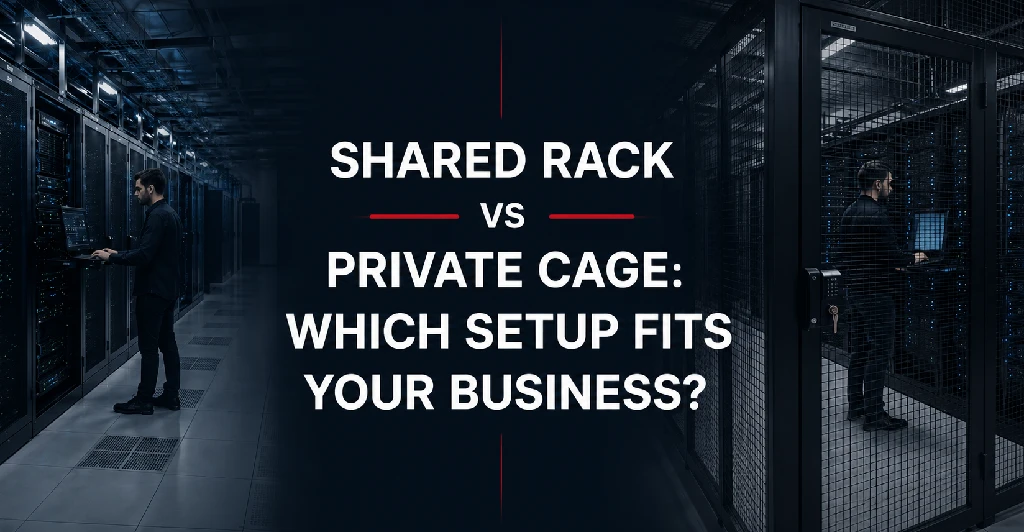
Not every organization moving into a data center environment needs the same infrastructure setup.
One of the most common decisions during colocation planning is whether to choose:
a shared rack environment
Or
a private cage environment.
At first glance, the difference may seem simple.
But the decision often affects:
- operational flexibility
- infrastructure growth
- security expectations
- support processes
- long-term infrastructure planning
Understanding where each model fits can help organizations avoid overbuilding too early — or outgrowing environments too quickly.
What Is a Shared Rack?
A shared rack environment allows organizations to colocate infrastructure inside a shared data center area.
Your equipment remains logically separated but physically located within a shared colocation environment.
Organizations typically purchase:
- rack units
- cabinet space
- power allocation
- connectivity
Think of it as:
Dedicated infrastructure inside a shared physical environment.
Shared racks often work well for:
- smaller infrastructure footprints
- initial colocation deployments
- predictable environments
- organizations optimizing costs
What Is a Private Cage?
A private cage is a dedicated, enclosed infrastructure environment inside a data center.
Instead of occupying part of a shared rack area, organizations receive an isolated section of infrastructure space.
Private cages may support:
- dedicated access
- operational separation
- controlled environments
- future expansion
Think of it as:
Your own infrastructure environment inside a larger facility.
Private cages are commonly evaluated by:
- enterprise organizations
- healthcare environments
- organizations with operational separation requirements
- growing infrastructure environments
Shared Rack vs Private Cage: Quick Comparison
| Category | Shared Rack | Private Cage |
| Physical Environment | Shared | Dedicated |
| Infrastructure Isolation | Moderate | Higher |
| Expansion Flexibility | Moderate | Higher |
| Initial Commitment | Lower | Higher |
| Operational Separation | Limited | Stronger |
| Growth Potential | Moderate | Greater |
| Access Control | Shared processes | More controlled |
| Enterprise Readiness | Moderate | Higher |
When Shared Rack Often Makes Sense
Shared rack environments are commonly considered when organizations:
Are Starting Their Colocation Journey
Moving infrastructure offsite without committing to large environments.
Have Predictable Capacity Needs
Infrastructure growth is stable and controlled.
Want Faster Deployment
Shared environments can often simplify initial implementation.
Want to Optimize Infrastructure Costs
Organizations only consume what they currently need.
Typical examples:
- smaller enterprise environments
- branch operations
- infrastructure pilots
- early migration projects
When Private Cage Often Makes More Sense
Private cages become more attractive when organizations prioritize:
Greater Operational Separation
Dedicated environments reduce dependency on shared infrastructure layouts.
Growth Planning
Infrastructure expansion can often happen more naturally.
Security Expectations
Organizations may want stronger control over infrastructure access.
Enterprise Operations
Larger environments often benefit from dedicated space.
Typical examples:
- healthcare organizations
- enterprise infrastructure
- regulated operations
- long-term deployments
When seeking comprehensive data center solutions that satisfy strict corporate auditing rules, private enclosures are usually the default selection.
Questions to Ask Before Choosing
How quickly do we expect infrastructure to grow?
Do we need dedicated operational space?
How often does our team access infrastructure?
Do security expectations influence layout decisions?
Would migration become difficult later?
Are we optimizing for today — or for three years from now?
Common Mistakes Organizations Make
Mistake 1: Choosing a private environment too early.
Bigger infrastructure does not automatically mean better infrastructure.
Mistake 2: Underestimating growth.
Choosing minimal, rigid space can create unnecessary migration headaches later. See our guide on how to choose a data center provider to properly map capacity requirements.
Mistake 3: Assuming security only means physical separation.
Processes matter too.
Mistake 4: Treating colocation as static.
Infrastructure environments evolve.
Decision Framework
| If You Prioritize… | Consider… |
| Lower initial commitment | Shared Rack |
| Faster deployment | Shared Rack |
| Infrastructure flexibility | Private Cage |
| Growth planning | Private Cage |
| Greater operational separation | Private Cage |
| Enterprise environments | Private Cage |
Final Thoughts
Shared rack and private cage environments solve different operational goals.
Neither option is universally better.
The stronger decision usually comes from understanding:
- current requirements
- growth expectations
- operational preferences
- access patterns
- infrastructure strategy
Organizations often benefit most when infrastructure decisions support both today’s needs and tomorrow’s expansion.
Evaluating colocation options? Contact us at Sierra Data Centers to discuss whether shared spaces or private infrastructure cages align best with your long-term operational goals, security frameworks, and ongoing management and support needs.
FAQs
What is a shared rack environment?
A shared rack environment allows organizations to colocate infrastructure within a shared facility while maintaining separation of their equipment.
What is a private cage in a data center?
A private cage is a dedicated infrastructure area designed for more isolated operations and future growth.
Is private cage infrastructure more secure?
Security depends on many factors, but private environments may provide additional operational separation.
Which option scales better?
Private cages often provide greater flexibility for infrastructure expansion.
Is shared rack enough for enterprise environments?
Some enterprise organizations begin with shared environments depending on operational requirements.