Shared rack space can be a practical starting point for businesses moving infrastructure into a data center. It allows companies to place a small amount of equipment in a professional facility without committing to a larger private environment.
But as infrastructure grows, shared rack space may become limiting.
A business may need more equipment, stronger physical separation, better access control, more power, cleaner cabling, improved security, or room for long-term expansion. At that point, private cage colocation may become a better fit.
Moving from shared rack space to a private cage is not only about adding more room. It is about creating a more secure, scalable, and manageable infrastructure environment.
What Is Shared Rack Space?
Shared rack space means a business uses part of a rack or cabinet inside a data center. Depending on the provider, the cabinet may be shared with other customers, or the business may lease a portion of a controlled rack environment.
Shared rack space is usually used for smaller infrastructure deployments.
This may include:
- A few servers
- A firewall
- A switch
- Backup equipment
- Small storage systems
- Test or secondary infrastructure
- Disaster recovery appliances
Shared rack space can be cost-effective and simple for businesses that do not need a large footprint.
It is often a good entry point into colocation.
What Is Private Cage Colocation?
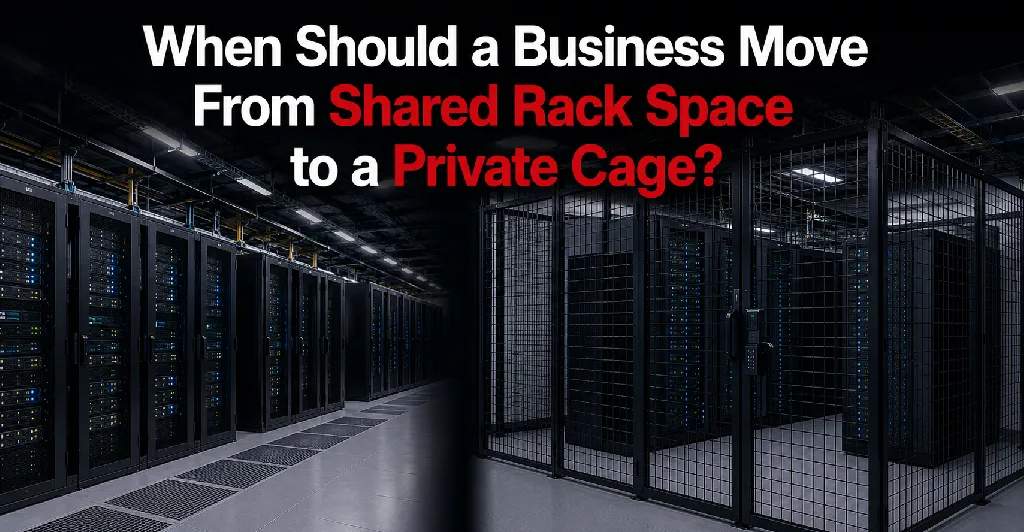
Private cage colocation gives a business a dedicated secured area inside a data center. Instead of using only part of a rack or one cabinet, the business has its own enclosed cage space for multiple racks, servers, storage systems, network equipment, and backup infrastructure.
A private cage is usually separated by fencing, mesh, or secure partitions. Access is restricted to authorized users, approved vendors, and data center staff following documented procedures.
Choosing private cages and suites services allows the business to use the data center’s power, cooling, connectivity, physical security, monitoring, and remote hands support while maintaining dedicated space for its own infrastructure.
Shared Rack vs Private Cage: The Main Difference
The main difference is control.
Shared rack space is usually best for smaller deployments where the business needs limited physical space and does not require a dedicated area.
Private cage colocation is better when the business needs more equipment space, stronger access control, better organization, and room to grow.
In simple terms:
- Shared rack space is suitable for smaller infrastructure needs.
- Private cage colocation is suitable for businesses that need a dedicated, secure, multi-rack environment.
If you’re weighing your options further, it helps to understand the difference between a private cage vs private suite before making a decision.
Sign 1: You Have Outgrown Your Current Rack Space
One of the clearest signs that your business may need a private cage is lack of room.
If your current rack space is becoming crowded, future changes become harder.
Signs you are outgrowing shared rack space include:
- Limited space for new servers
- No room for additional storage
- Network equipment becoming cramped
- Poor cable organization
- Difficult maintenance access
- No space for backup appliances
- No room for future hardware
- Equipment installed too close together
- Lack of separation between production and backup systems
A private cage can provide more space for current infrastructure and future expansion.
Instead of adding equipment in a crowded rack, the business can design a cleaner environment with multiple racks and better layout planning.
Knowing exactly when to move from shared rack to private cage prevents your team from facing critical space bottlenecks during a refresh.
Sign 2: Your Infrastructure Has Become Business-Critical
Shared rack space may be enough for secondary systems or small deployments. But if the infrastructure now supports critical business operations, the environment may need more control.
This includes systems such as:
- Customer-facing applications
- ERP systems
- Healthcare platforms
- Financial systems
- Manufacturing applications
- Internal business systems
- Remote workforce access
- Multi-location network infrastructure
- Backup and recovery systems
When infrastructure becomes central to daily operations, the business should evaluate whether shared space provides enough security, access control, scalability, and operational flexibility. Moving to dedicated data center hosting services can provide a more structured, resilient environment for critical systems.
Sign 3: You Need Stronger Physical Security
Physical security is a common reason businesses move from shared rack space to private cage colocation.
Shared rack space may provide cabinet-level security, but a private cage creates a dedicated physical boundary around the business’s infrastructure.
This can help with:
- Restricted access
- Clear equipment separation
- Vendor control
- Audit readiness
- Security documentation
- Reduced exposure to shared environments
- Better access logging
- Stronger operational control
For businesses in healthcare, financial services, manufacturing, enterprise IT, or other sensitive industries, private cage colocation may better support internal security expectations. It’s also worth reviewing what to look for in a secure data center facility before selecting a provider.
Sign 4: You Have Compliance or Audit Requirements
Compliance requirements can influence data center space decisions.
A business may need to show that infrastructure access is restricted, documented, monitored, and controlled. A private cage can make this easier than shared rack space.
A private cage may support:
- Dedicated infrastructure separation
- Controlled access lists
- Visitor and vendor access procedures
- Access logs
- Camera monitoring
- Hardware chain-of-custody practices
- More organized audit documentation
- Stronger physical security controls
Utilizing a comprehensive data center compliance checklist can help verify that your footprint aligns with regulatory standards. While a private cage does not automatically make a business compliant, it supports a stronger compliance posture when combined with proper internal policies, documentation, and technical controls.
Sign 5: You Need More Control Over Access
As infrastructure grows, more people may need access to the environment.
This may include:
- Internal IT staff
- Network vendors
- Hardware vendors
- Managed service providers
- Security teams
- Compliance reviewers
- Remote hands technicians
- Application owners
In shared rack space, access procedures may be more limited or less flexible.
A private cage can make access control more manageable because the business has a dedicated area with clear authorization rules.
Before moving to a private cage, businesses should define:
- Who can access the cage?
- Who can approve access?
- How will vendor visits be handled?
- How will remote hands access be documented?
- Are emergency access procedures defined?
- Are access logs available for review?
Access control becomes more important as infrastructure becomes more sensitive.
Sign 6: You Need More Power Capacity
A business may run out of power capacity before it runs out of physical rack space.
Servers, storage systems, switches, firewalls, and backup appliances all require power. As equipment density grows, shared rack space may no longer support the required load.
Signs of power limitations include:
- Limited ability to add equipment
- High rack power usage
- Need for additional circuits
- More dual-power equipment
- Higher-density servers
- More storage systems
- Backup infrastructure expansion
- Need for better power separation
Private cage colocation allows power planning across multiple racks and can support more structured growth. Understanding what power redundancy is in a data center is a good first step.
Businesses should evaluate power needs before the current environment becomes a bottleneck.
Sign 7: Cooling and Airflow Are Becoming Harder to Manage
More equipment means more heat.
In shared rack space, cooling may become a concern if equipment is densely packed, cables block airflow, or there is limited flexibility in rack layout.
Warning signs include:
- Hot spots
- Crowded cabinets
- Poor cable routing
- Limited airflow around equipment
- High-density hardware
- No room for blanking panels
- Difficult access for maintenance
- Equipment temperature alerts
A private cage gives the business more flexibility to plan rack layout, airflow, and equipment placement.
Cooling should be planned alongside power and rack space, especially for growing infrastructure environments — see data center cooling explained for more detail.
Sign 8: Cabling Has Become Difficult to Manage
Cabling problems are one of the most practical signs that a business needs more space.
In a shared rack or limited cabinet environment, cables may become crowded as equipment grows.
Poor cabling can cause:
- Troubleshooting delays
- Airflow problems
- Accidental disconnections
- Messy maintenance work
- Limited room for new connections
- Harder remote hands support
- Network documentation issues
A private cage allows better cable management across multiple racks. It also gives the business room for patch panels, switches, cross-connect organization, labeling, and future changes as part of a well-planned data center infrastructure.
Clean cabling supports reliability and faster support.
Sign 9: Your Connectivity Needs Are Growing
As businesses grow, connectivity requirements often become more complex.
The business may need:
- Multiple carriers
- Redundant internet connections
- Cross-connects
- Private network connections
- Cloud connectivity
- Branch office connectivity
- VPN infrastructure
- Firewall pairs
- Redundant switches
- Dedicated routing equipment
Shared rack space may become limiting if the network environment grows beyond a simple setup. Upgrading to robust connectivity solutions within a private cage provides dedicated space for network equipment, carrier handoffs, redundant paths, and a more organized connectivity design.
This is especially important for multi-location businesses and companies that depend heavily on uptime.
Sign 10: You Need Better Disaster Recovery Infrastructure
Disaster recovery planning may require additional infrastructure.
This can include:
- Backup servers
- Replication targets
- Storage appliances
- Recovery network equipment
- Standby systems
- Failover hardware
- Offsite backup infrastructure
If disaster recovery equipment is being added to an already crowded rack, deploying dedicated disaster recovery solutions within a private cage provides a better long-term environment.
A private cage helps cleanly separate production, backup, and recovery systems while keeping them in a secure, professionally managed facility.
Sign 11: You Are Planning Long-Term Growth
A business should not wait until its infrastructure is already difficult to manage before considering a private cage.
Future growth may include:
- More users
- More locations
- More applications
- More storage
- More backup data
- Higher bandwidth
- New compliance requirements
- More customer-facing systems
- Business acquisitions
- New manufacturing sites or offices
Before making the jump, it is wise to calculate exactly how much rack space your business needs over the next three to five years. If substantial growth is likely, private cage colocation provides a scalable foundation that reduces the need for another complex migration later.
Sign 12: You Need More Operational Flexibility
Shared rack space can be efficient, but it may limit how infrastructure is organized and maintained.
Private cage colocation gives businesses more flexibility to:
- Add racks
- Separate network and server equipment
- Organize backup systems
- Plan redundant infrastructure
- Allow controlled vendor access
- Improve cable management
- Support remote hands tasks
- Stage new hardware
- Plan maintenance windows
- Expand over time
This flexibility can reduce friction for internal IT teams, particularly when paired with dedicated data center hosting services.
Sign 13: Remote Hands Support Would Be Easier With a Dedicated Space
Remote hands support can be more effective when the infrastructure is well-organized and clearly separated.
In a private cage, technicians can more easily identify equipment, follow labeling standards, verify cables, inspect devices, and assist with hardware tasks.
This can help with:
- Reboots
- Cable checks
- Hardware replacement
- Visual inspections
- Vendor support
- New equipment installation
- Post-migration troubleshooting
- Emergency response
A dedicated cage environment can make support faster and more reliable, especially when internal staff are not on-site.
Sign 14: You Want Separation Between Production and Other Systems
As environments grow, businesses may want to separate different infrastructure groups.
For example:
- Production systems
- Backup systems
- Disaster recovery equipment
- Network equipment
- Security devices
- Development or testing systems
- Vendor-managed equipment
Shared rack space may not provide enough room or structure for that separation.
A private cage can support a more organized layout, which makes management and troubleshooting easier.
Sign 15: You Are Spending Too Much Time Managing Space Constraints
If your IT team is constantly working around space limitations, the current environment may be slowing operations down.
Examples include:
- Rearranging equipment to make room
- Delaying new hardware installations
- Struggling with cable changes
- Working around limited power
- Avoiding upgrades because space is tight
- Using temporary setups
- Making maintenance harder than necessary
At that point, the business is paying for hidden operational inefficiency. Moving to a dedicated colocation services layout reduces day-to-day friction and supports a highly professional infrastructure layout.
Shared Rack vs Private Cage Cost Considerations
Private cage colocation usually costs more than shared rack space because it provides dedicated secured space, more capacity, and more operational flexibility.
However, the cost should be compared against business risk and infrastructure needs.
A private cage may be worth considering if shared rack limitations create:
- Higher downtime risk
- Slower troubleshooting
- Limited growth
- Poor cable management
- Compliance challenges
- Security concerns
- Repeated migration needs
- Operational inefficiency
The lowest-cost option is not always the best option if infrastructure is critical to the business — it also helps to understand what’s covered under a data center SLA explained before comparing pricing.
How to Plan the Move From Shared Rack to Private Cage
Moving from shared rack space to a private cage should be planned carefully.
Steps may include:
- Review current infrastructure
- Create equipment inventory
- Identify future growth needs
- Calculate rack requirements
- Review power and cooling needs
- Plan network layout
- Map cable paths
- Define access control procedures
- Review security requirements
- Confirm compliance needs
- Plan migration timing
- Coordinate vendors
- Confirm remote hands support
- Test systems after relocation
Whether this move happens inside your current facility or involves migrating to a new region entirely, using a detailed data center migration checklist helps minimize downtime.
For step-by-step physical transport advice, businesses should follow a guide on how to move servers to a colocation facility safely.
Private Cage Colocation Checklist
Before moving to a private cage, confirm:
- Current rack space is near capacity
- Growth needs are documented
- Rack count is estimated
- Power requirements are calculated
- Cooling requirements are reviewed
- Connectivity needs are planned
- Security needs are documented
- Compliance requirements are considered
- Access control process is defined
- Vendor access needs are identified
- Remote hands support is available
- Cable management plan is created
- Backup and disaster recovery systems are included
- Future expansion is considered
- Budget is aligned with business risk
- Migration timeline is planned
This checklist helps businesses decide whether private cage colocation is the right next step.
Questions to Ask a Data Center Provider
Before moving from shared rack space to a private cage, ask:
- What private cage options are available?
- How many racks can the cage support?
- Can the cage expand later?
- What power capacity is available?
- Are A and B power feeds available?
- How is cooling handled?
- What connectivity options are available?
- Is the facility carrier-neutral?
- How is cage access controlled?
- Are access logs available?
- Can remote hands support the cage environment?
- Can vendors be escorted?
- How are cross-connects handled?
- What is the migration process?
- What costs are included?
- What happens if we outgrow the cage?
These questions help the business compare options and avoid short-term decisions that create long-term limits.
Common Mistakes When Choosing Between Shared Rack and Private Cage
Mistake 1: Choosing a private environment too early.
Bigger infrastructure does not automatically mean better infrastructure.
Mistake 2: Underestimating growth.
Choosing minimal, rigid space can create unnecessary migration headaches later. See our guide on how to choose a data center provider to properly map capacity requirements.
Mistake 3: Assuming security only means physical separation.
Processes matter too.
Mistake 4: Treating colocation as static.
Infrastructure environments evolve.
Is It Time to Move to Private Cage Colocation?
A business should consider private cage colocation when shared rack space no longer supports its operational, security, compliance, or growth needs.
The move may be appropriate if:
- Infrastructure is business-critical
- Equipment is outgrowing shared rack space
- More power or cooling is needed
- Cabling has become difficult to manage
- Connectivity needs are more complex
- Compliance requires stronger controls
- Access control needs are increasing
- Disaster recovery infrastructure is expanding
- Future growth is expected
Private cage colocation gives businesses a dedicated, secure environment while still using the advantages of professional data center infrastructure.
Plan Private Cage Colocation With Sierra Data Centers
Sierra Data Centers supports businesses with secure colocation, private cages, private suites, data center hosting, carrier-neutral connectivity, remote hands support, and disaster recovery planning.
Whether your organization is outgrowing shared rack space, adding critical infrastructure, or planning a more secure and scalable environment, we can help evaluate your rack, power, cooling, connectivity, and growth requirements.
If your business is considering private cage colocation, feel free to contact us to plan your next step with greater confidence.